Home>MOLDNEWS REVIEW>MOLDNEWS REVIEW>Vol.1 Issue 2 — August 2026>Cladosporium Under the Magnifying Glass


Cladosporium Under the Magnifying Glass
MOLD SCIENCE · MOLDNEWS REVIEW
By the YCM Mold Research Center · Summer 2026 · MoldNews Review Vol.1 Issue 2
Is this common mold lurking in your home?
his fungus appears everywhere from soil to the air inside our homes. Cladosporium relies on spores that travel with ease across its environment. While they play a vital role as decomposers, breaking down organic material, their behavior shifts when conditions align, allowing them to turn into pathogens that threaten both plants and animals.
These fungi are known triggers for respiratory issues like asthma and allergic pneumonitis, while also occasionally leading to skin lesions or ocular conditions. The spores of Cladosporium are incredibly small, measuring between 3-35 μm, and they are light enough to remain airborne for months, which drastically increases the risk of indoor air
contamination, especially in spaces where ventilation is poor.
Research History in Medicine and Environmental Science
Cladosporium has long interested both medical and environmental scientists because it is so widespread. Medically, early studies focused on how Cladosporium acts as a pathogen, particularly its role in triggering allergic and respiratory diseases. Research has since confirmed that these fungi contribute to a variety of allergic conditions, including rhinitis and asthma, and can cause allergic bronchopulmonary aspergillosis (ABPA), particularly in those with suppressed immune systems.
In environmental science, research has moved from classification and distribution toward understanding the fungus's ecological role. While they are key decomposers that support ecological balance, recent studies on indoor air quality have linked Cladosporium to high humidity, mold growth, and the structural degradation of building materials.
Onychomycosis
Cladosporium has been identified as a cause of white superficial onychomycosis, which is an infection that presents as white patches on the surface layer of the
nail bed, eventually causing the nail to become brittle and rough.
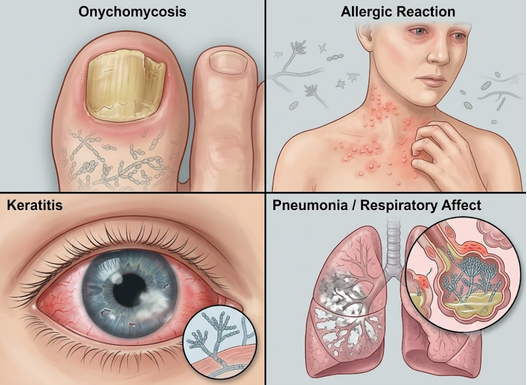
To diagnose this, medical doctors typically collect samples from the nail bed and conduct a microbiological culture, looking specifically at growth speed and the texture and color of the colonies to confirm this pathogen. Under a light microscope, Cladosporium is identified by its brown spores and the distinct shield-shaped cells found within the infected skin tissue.
The fungus releases enzymes and toxins during growth that break down the nail’s structure. These metabolites trigger the host's immune response, resulting in localized inflammation. Understanding these mechanisms is essential for the future development of effective antifungal treatments.
Allergic Reactions
When discussing the impact of indoor air quality on health, the presence of Cladosporium should be especially noted. Research discovered that the concentration of mold spores in the air had a direct impact on the frequency of respiratory symptoms in residents.
By entering the respiratory tract, these spores provoke an allergic immune response, leading to irritation and damage to the mucosal lining. Beyond simple allergies, these spores can also trigger serious conditions like asthma and allergic pneumonitis, and some evidence suggests that the toxins, such as ergot alkaloids, can worsen these symptoms. Therefore, controlling indoor mold growth is essential for respiratory health and indoor air quality.
Fungal Keratitis
Keratitis caused by Cladosporium is a particularly difficult infection to treat, and failing to provide timely, appropriate care can lead to serious consequences, including blurred vision or even total blindness.
In a real-life case, a 62-year-old construction worker suffered from eye redness, intense pain, blurred vision, and a sensation of having a foreign object in his eye after being struck by dust at work. Although he was treated with several antifungal medications, including natamycin, fluconazole, and amphotericin B, his condition only began to improve after his regimen was switched to both topical and systemic voriconazole.
While Cladosporium is common in the natural environment, its ability to penetrate the human cornea makes it a serious threat, especially for those who work in dusty environments or have a history of eye trauma.
Pneumonia-Related Diseases
A 2009 study provided a look into two cases of home-based hypersensitivity pneumonitis sparked by Cladosporium. In the first instance, a 47-year-old woman was hospitalized with severe coughing and breathing difficulties, which were later attributed to a high antibody count against Cladosporium cladosporioides. Her environment was found to have a high concentration of mold spores, and her symptoms spiked whenever her air conditioning was turned on, indicating that AC systems can act as a delivery mechanism for mold.
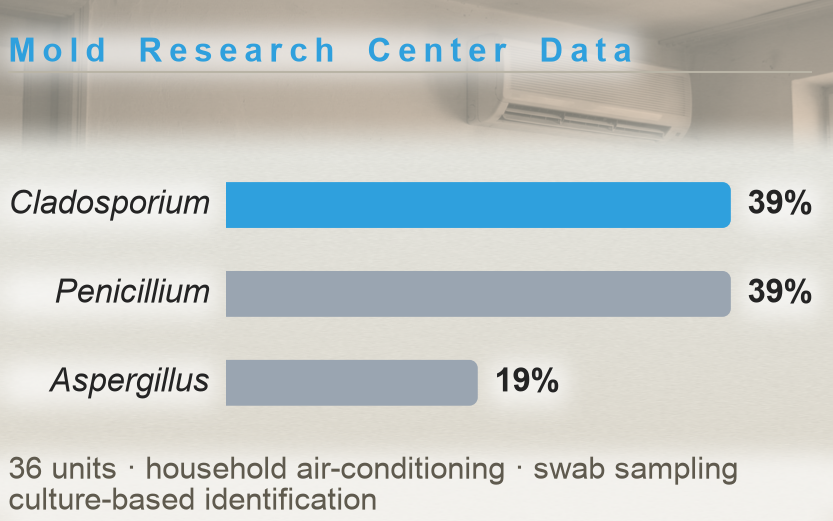
This pattern is not confined to case reports. In Mold Research Center's survey of 36 household air-conditioning units, Cladosporium was recovered from 39% of units — tied with Penicillium as the most frequently detected genus.
The second case involved a 72-year-old woman, initially misdiagnosed with idiopathic pulmonary fibrosis. Later it was revealed to be chronic hypersensitivity pneumonitis caused by Cladosporium herbarum in her own home.
Both cases show that neglecting dampness at home can have long-term consequences for respiratory health, making indoor mold eradication a priority.