A New Era of Health Challenge
RISK IN FOCUS · MOLDNEWS REVIEW
By the YCM Mold Research Center · Summer 2026 · MoldNews Review Vol.1 Issue 2
How fungal infections have evolved?
ungal infections have been around for thousands of years. Due to the lack of understanding in the past, they were difficult to diagnose and treat. Thanks to advancements in modern technology, scientists and doctors have learned much more about the study of fungi (mycology), which has significantly improved how we identify and treat these infections today.
However, research into fungal infections still falls far behind research into diseases caused by bacteria, viruses, and other parasites. In reality, though, fungal infections often have higher mortality rates. For example, one study found that the mortality rate for liver-related fungal infections was 93%, compared to 52% for bacterial infections.
Because of this, fungal diseases are rising quietly, without the public realizing it. Even factors like climate change are expanding the areas where fungi can grow, and the COVID-19 pandemic has also made it easier for opportunistic fungal pathogens to infect humans. Unfortunately, our current medical defenses are becoming less effective due to the overuse of drugs and the way fungi are mutating. This article looks at our current battle against fungal diseases and how recent events have made treatment more challenging, in the hope of drawing more attention to the rising threat of invasive fungal infections.
Impact of Climate Change on Mold Growth
Before COVID-19, fungal infections were caused by weaker immune systems, whether due to age, genetics, post-surgery recovery, or long-term exposure to moldy environments. Fungal pathogens are typically opportunistic, meaning they wait for a weakness in the host to strike. Because these infections were relatively uncommon in the general population, they rarely made headlines. Everything changed when COVID-19 emerged in 2019 and was declared a pandemic by the World Health Organization (WHO) in 2020. COVID-19 is a respiratory disease that also causes various other health complications. As of August 3, 2025, over 778 million cases have been reported to the WHO.
While COVID-19 victims mainly fought against the virus, many patients were also unexpectedly hit by following fungal infections, with three main types:
COVID-19-associated pulmonary aspergillosis (CAPA)
COVID-19-associated mucormycosis (CAM), and
COVID-19-associated candidiasis (CAC)
1. CAPA
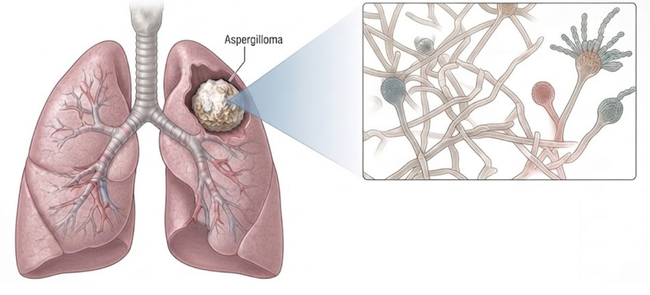
This disease was the most prevalent type, estimated to affect 10% of COVID-19 patients. During the early stages of the pandemic, medical examination of the airway was rarely done, not wanting to risk COVID-19 transmission. However, because aspergillosis also targets the respiratory system, CAPA cases were easily missed during this period. Aspergillus fumigatus is the main culprit of CAPA, known for its high resistance to common antifungal drugs. Because of this late detection, CAPA has an alarming death rate of nearly 80%. This highlights how vital it is for medical professionals to be aware of potential CAPA cases to ensure patients get the precise treatment they need throughout their recovery.
2. CAM
CAM is an infection caused by Mucorales fungi, such as Rhizopus sp., occurring in patients who are also infected with COVID-19. It first gained attention after outbreaks in India, where it was mislabelled as the "black fungus" pandemic because it caused the patient's skin to darken or turn black. In India, these infections were common even before the COVID-19 pandemic; however, they surged during the second wave, linked to environmental factors and the overuse of drugs. While CAM was 70 times higher in India, cases were also reported in other continents. Therefore, it is possible that the global impact of CAM is being underestimated, creating a gap between the reality of the situation and our current understanding.
3. CAC

CAC, linked to Candida albicans, it was first recorded in a COVID-19 patient in February 2020. Candida is notorious for its ability to grow easily on various surfaces, including human skin and hospital ventilation systems, becoming one of the major opportunistic yeast risks for patients with long hospital stays. Since it is common for severe COVID-19 patients to be placed in the ICU, they are at higher risk for this yeast infection. Research shows that COVID-19 patients were at least twice as likely to contract a Candida infection compared to patients without COVID-19. Consequently, the complications of CAC should not be taken lightly.
Distribution Expansion
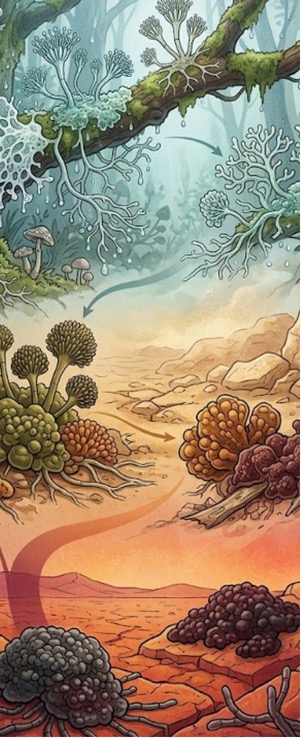
Climate change is a major topic in the 21st century, as rising global temperatures shift weather patterns and cause sea levels to rise. This global warming creates "thermal stress," which forces organisms, including fungi, to evolve and adapt to these new, hotter environments.
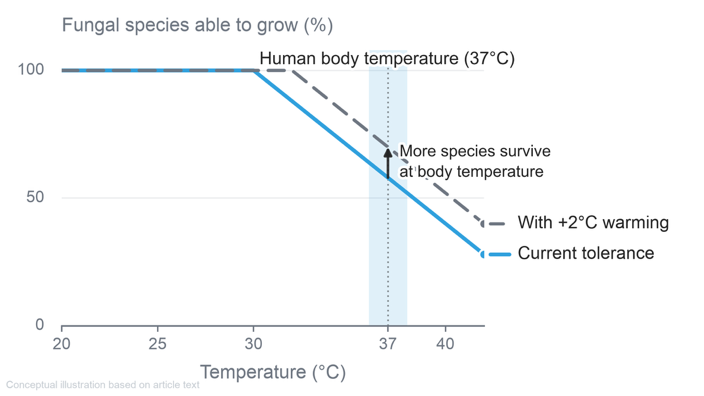
Starting from 30 ℃, each 1 ℃ increase leads to another 6% of fungal species not being able to tolerate such temperatures. As the normal temperature of the human body is about 37 ℃, mold typically cannot survive inside of the human body. However, as global temperatures rise, more fungi are becoming heat-resistant. This allows them to survive at human body temperatures, making them opportunistic and capable of infecting humans, even those that were never previously considered dangerous as human pathogens.
The urban heat-island effect showed that fungi sampled from hot urban areas were found to be able to survive in temperatures 2 ℃ higher than those from nearby, cooler rural areas, even though they were the same species.
Several examples of this shift are already occurring. Fusarium, once mostly a plant pathogen, would only cause infections to humans who had particularly weaker immune systems. However, recently, reports of skin and eye infections in humans caused by Fusarium are rising, especially in tropical regions.
Candida auris, normally a plant decomposer yeast, was found to behave differently in mammals: samples taken from mammals showed much greater heat tolerance and faster growth than those taken from the environment. This finding suggests that this species has evolved and can eventually become a human pathogen by adapting to heat.
While rare mold infections were once seldom documented, data from 2021 showed that Australia, America, Argentina, and France reported more than 3 cases of rare mold infections for every 1 million people.
To address these evolving threats, the WHO created a priority list in 2022 of fungal species that pose the greatest risk to human health, such as C. auris and Fusarium oxysporum. While this list helps guide global research, experts note that there is still a lack of centralized databases for tracking these infections globally, even in developed nations.
Greater Anti-fungal Drug Resistance
With the support of the WHO's list of priority fungal pathogens, a clear solution to fight these fungi is to create new drugs, but this is easier said than done.
Antifungal treatments are generally grouped by how they stop fungi, usually by damaging the cell wall or cell membrane. Some drugs are effective treatments for certain species but work less effectively on other species. Resistance to antifungal drugs has also shown to almost double within a decade, suggesting that fungal pathogens are becoming more resistant and widespread.
Fungi use various methods to gain this resistance. Some strains can lower the drug's effectiveness by producing proteins that actively remove the drug's chemicals from their cells. Another way is to produce more of the specific target molecule that the drug is meant to attack. Because the drug is meant to bind to the protein to break it down, the fungus produces more protein than the drug can bind to, which dilutes the medication and reduces its effectiveness.
C. auris is not only invasive and common but also resistant to most treatments, and some strains have been reported to be resistant to all currently available antifungals.
Fungi may be forced to develop this resistance through the overuse of treatments. Sometimes they are even prescribed to patients who have not yet been confirmed to have an infection, which allows the fungi the chance to adapt and mutate. Furthermore, as these drugs are used as fungicides in agriculture, it further increases the risk of fungi developing resistance.
While modern technology has allowed us to learn more about the complex nature of fungi, there is still much that scientists do not know. With new stress factors creating opportunities and locations for infections, and with fungi evolving into new, resistant strains, the battle against the rise of fungal infections is becoming more difficult.
Fungal infections need more dedicated research funding and attention. The WHO's priority list of fungal pathogens is a major development because it provides a clear direction on which species are most urgent to address, even if the data collected has potential biases. However, this also highlights a lack of centralized databases for tracking fungal infections globally.
Both clinicians and the public need to recognize the early symptoms of fungal infections. Although the increase in reported cases has only been observed recently, this is likely because the public only recently became aware of the symptoms and sought care. The underlying changes may have started long ago and only now become widespread enough to notice. Therefore, research in this area must be sped up before the gap in our understanding of fungi grows even wider.