Water: The Determining Factor in Mold Growth
FUNDAMENTALS · MOLDNEWS REVIEW
By the YCM Mold Research Center · July 2026 · MoldNews Review Vol.1 Issue 1, p.15
Of all the conditions mold needs, water is the one that decides everything—from spore germination to persistent growth on real-world materials.
Within our daily environment, mold spores act like tiny “time capsules,” drifting through the air or sitting on surfaces in a deep, silent sleep. For researchers and homeowners alike, the million-dollar question has always been: what exactly triggers these dormant spores to suddenly “wake up” and start growing?
Maybe it’s the warmth of the room that coaxed them out?
Perhaps they finally found a source of nutrients to feast on?
Or maybe it was the presence of oxygen that gave them a breath of life?
While it is true that temperature, food sources, and oxygen levels determine how fast or how thick the mold grows, none of them hold the ultimate power. After countless experiments, researchers discovered a striking reality: even with the perfect temperature and a feast of nutrients, a mold spore will never hit the “start” button without one vital ingredient—Moisture.
Fundamental Concepts of Spore Germination
Mold spores can be thought of as the “seeds” of the fungal world, but they travel much lighter than the seeds of a sunflower or a bean. While a plant seed packs a heavy suitcase full of starches, fats, and proteins to fuel its early growth, a mold spore is a minimalist. It carries only the bare essentials—just enough energy and a few protective molecules to survive in harsh, dry environments. This “travel light” strategy allows spores to remain dormant for years, waiting patiently for the perfect moment to strike.
Behind their tough, multi-layered walls, these dormant spores are masters of survival. They are shielded by specialized water-repellent coatings and pigments that guard against drought, UV rays, and environmental stress. Inside, everything is at a standstill: metabolism drops to near zero, and the cell’s internal machinery is locked in a deep freeze to save every drop of energy. It is a state of perfect, suspended animation.
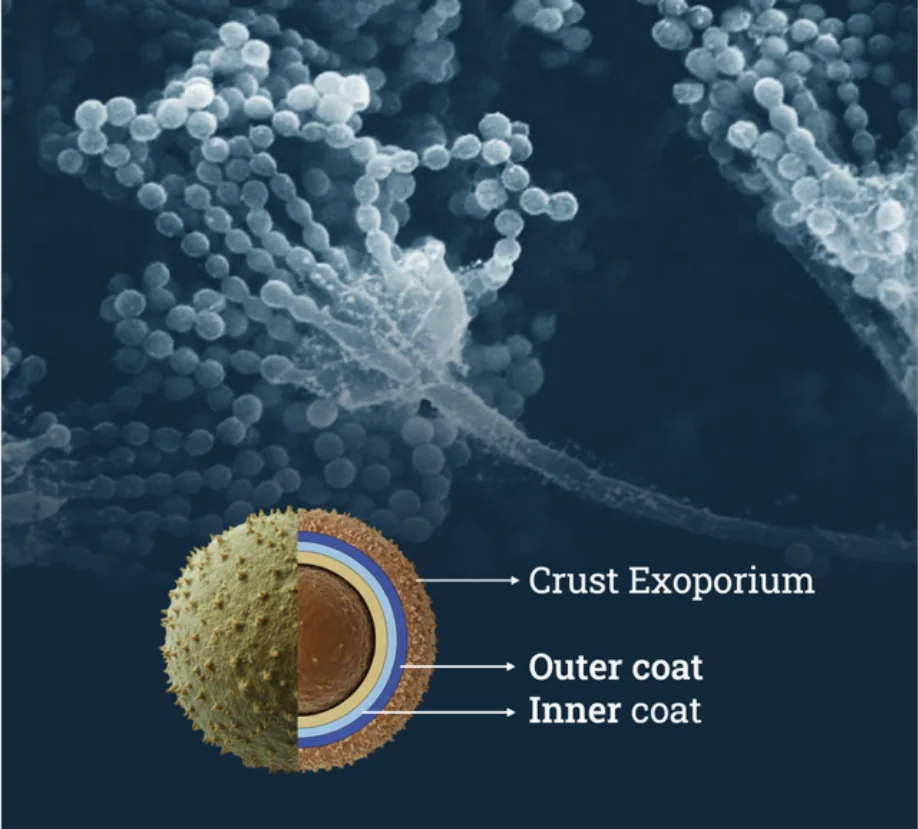
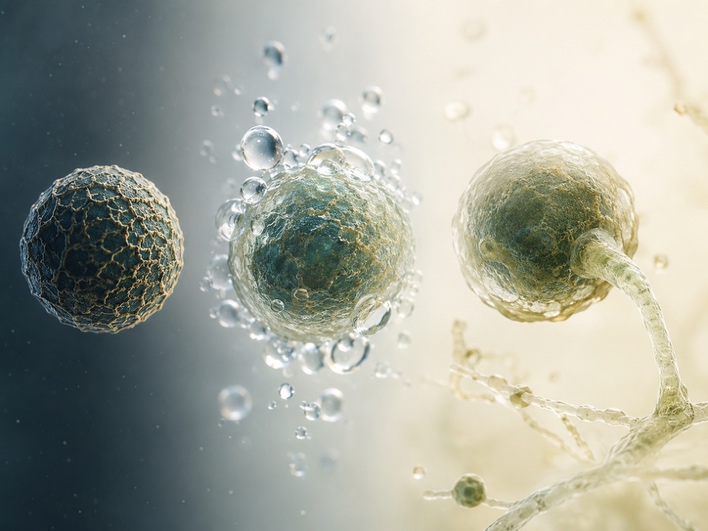
The arrival of moisture, however, changes everything in an instant. The moment water becomes available, the spore begins to soak it up like a sponge, swelling in size as its protective armor softens. This “hydration” is the spark that reignites the engine of life. Within just 6 to 12 hours, a tiny germ tube—the first sign of a new mold colony—bursts through the spore wall. In less than two days, what started as a microscopic speck can grow into a visible colony. In some aggressive species, like the common black bread mold, this entire transformation happens even faster, turning a “silent seed” into a growing organism before we even realize it’s there.
The Necessity and Sufficiency of Water in Spore Germination
Water is the ultimate “on-off” switch for mold; without it, the machinery of life simply stays frozen. Even if a spore is surrounded by oxygen and sitting on a feast of nutrients, it will remain in a deep sleep as long as the environment is dry. But the moment moisture hits a critical threshold, the transformation is electric. The cell walls swell, dormant enzymes wake up, and the first germ tubes punch through their protective armor. In the world of mold, moisture isn’t just a helpful neighbor—it is the landlord that decides when the doors open.
Mold species, however, don’t all agree on how much water they need to “wake up.” Scientists have spent decades measuring these requirements using a scale called water activity. For instance, the common black mold Aspergillus niger usually waits until moisture levels reach about 0.83, while the Penicillium we often find on damp walls and cardboard can start growing at 0.79. These numbers might seem like technical jargon, but they reveal a hidden truth: mold is much more resourceful than we imagine, and its “thirst” is often much easier to quench than we’d like to believe.
But the most striking discovery challenges our very definition of “dry.” While we might think mold only grows in soggy basements or during humid summers, a specialized mold called Aspergillus penicillioides can germinate at a water activity as low as 0.58. To put that into perspective, that is roughly 58% relative humidity—the exact level most of us consider “perfectly comfortable” in our homes. This “xerophilic” (dry-loving) mold serves as a powerful reminder: the danger zone isn’t just a damp, dripping corner. Sometimes, the spores are waking up in the very air we think is safe.

Factors Shaping Hyphal Growth Rate and Persistence
Moisture stands as the undisputed gatekeeper of the microbial world. It is the primary condition that determines whether a spore can initiate its life cycle. Without moisture, spores remain entirely static—frozen in a dormant state—regardless of how favorable other environmental factors might be. Only after moisture levels cross the critical threshold do temperature and nutrients begin to exert their secondary influence on the mold’s development.
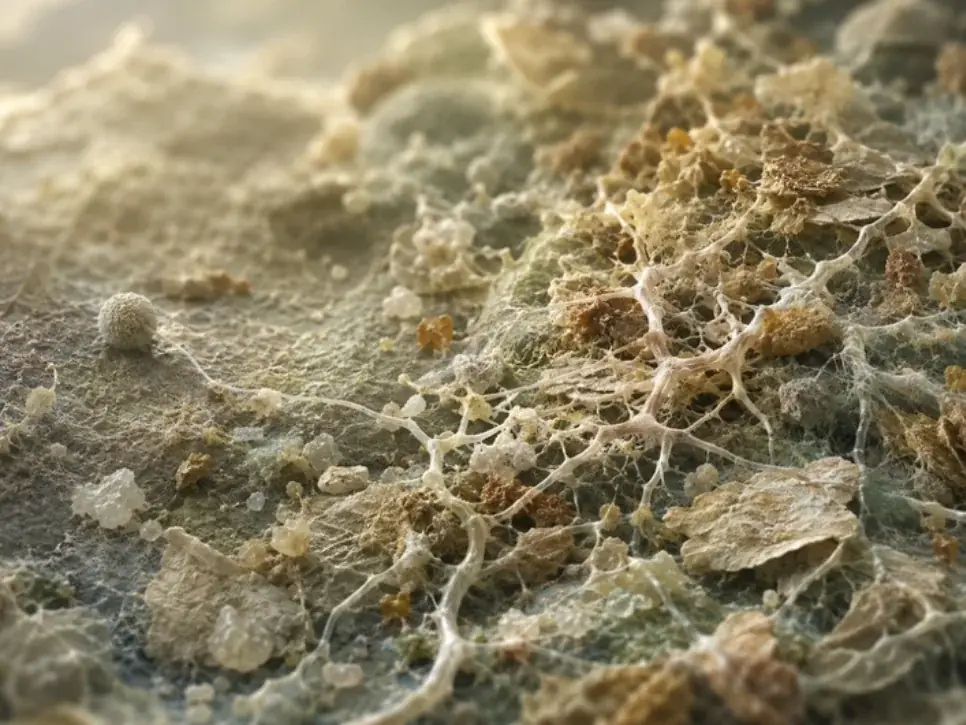
Temperature acts as the “metabolic accelerator,” primarily dictating the duration of the lag period and the subsequent growth rate. Extensive experiments, such as those conducted by Ayerst (1969), demonstrate that even with adequate moisture, low temperatures can significantly stall the germination process. However, this is often just a temporary pause; once temperatures return to a suitable range, the biological clock resumes. In essence, temperature controls the “tempo” of the invasion, governing how quickly a microscopic spore transforms into a visible problem.
Nutrients serve as the essential fuel for sustaining growth rather than the initial spark. A spore’s internal energy is remarkably limited; relying solely on its own reserves, a germ tube can typically extend no more than 0.1 micrometers in length. Research indicates that in environments of pure water, about 40% of Aspergillus nidulans spores can achieve germination, while only 5% of Aspergillus niger spores manage to do so. While they may “wake up,” they cannot build a lasting colony without external help. However, when the environment provides even basic glucose or inorganic salts—often found in household dust, skin flakes, or food residues—germination rates skyrocket, allowing those tiny tubes to extend into the mature, sprawling networks we recognize as mold.
Moisture in Industrial Reality
Moisture in industrial settings rarely appears as an obvious “splash of water.” Instead, it creeps in through subtle environmental shifts that quietly push surface water activity past the danger zone. These hidden culprits include short-term spikes in humidity, micro-condensation from temperature swings, the natural “thirst” (hygroscopicity) of certain materials, and stagnant microclimates caused by poor ventilation. In many cases, a surface that looks perfectly dry to the naked eye is already moist enough for a spore to begin its journey.
Cardboard, textiles, leather, and foam act like sponges in a warehouse, absorbing moisture within hours when nighttime temperatures drop and relative humidity climbs to 75–85%. During container transport, “cargo sweat” can rapidly saturate packaging and wood without ever leaving a visible puddle. Even in manufacturing, processes like applying adhesives or cooling after hot-pressing can create transient moisture films. When these materials—whether fabrics or sponges—are stacked tightly or pushed against cold walls, they create “cold spots” and trapped air, leading to latent moisture absorption that is nearly impossible to detect through casual inspection.
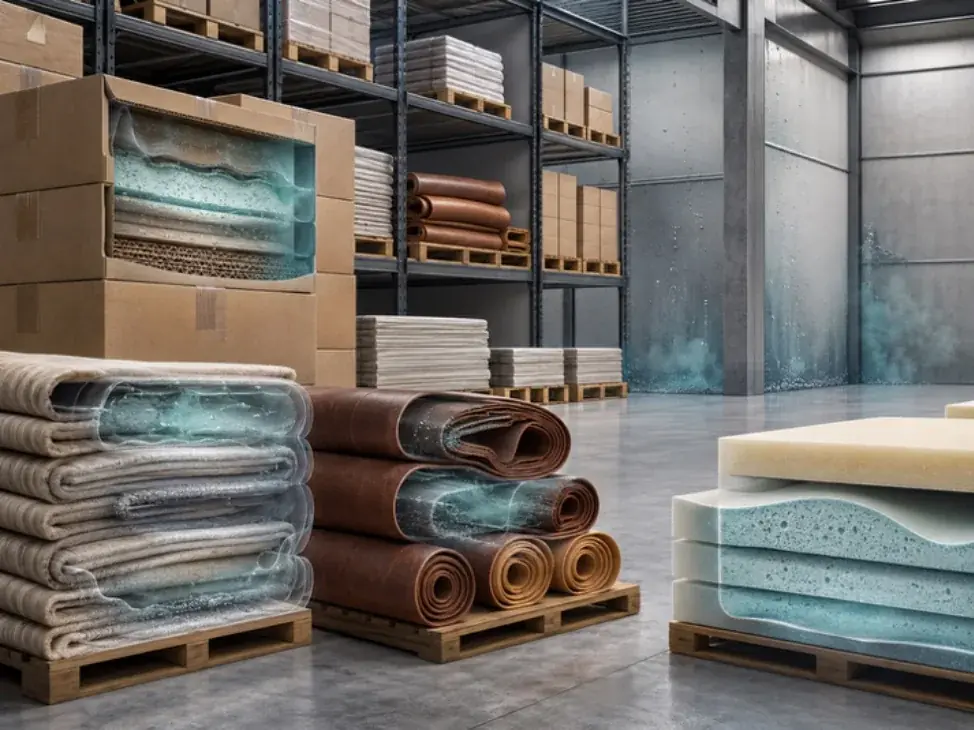
Although these humidity events are often brief, they are more than enough to open the “risk window” for mold germination. This explains the frustrating mystery many factory managers face: why mold suddenly appears “out of nowhere” in environments that seem perfectly dry. It isn’t a miracle; it’s a microscopic response to a series of minor, yet sufficient, moisture events that we often overlook in our daily operations.
Conclusion
Moisture is the true starting point of mold growth. Temperature and nutrients may influence how fast mold develops, but without sufficient water availability, spores remain dormant. Therefore, mold prevention should focus first on moisture control, especially by monitoring environmental relative humidity as a practical field indicator.
When relative humidity stays elevated for several days, even surfaces that appear dry may provide enough moisture for spores to germinate. For factories, warehouses, packaging, textiles, leather, and logistics environments, this means that short periods of humidity control failure can already create mold risk.
In the future, mold prevention should move from simple humidity control toward predictive risk management by linking relative humidity, material water activity, and spore germination behavior. Controlling moisture means controlling the very beginning of mold problem.