
Climate Change & the Emerging Risk of Mold Diversity
RISK OUTLOOK · MOLDNEWS REVIEW
By the YCM Mold Research Center · July 2026 · MoldNews Review Vol.1 Issue 1, p.25
How warming, shifting humidity, extreme rainfall, and flooding are changing fungal geography, diversity, and the future of mold risk.
Climate change is no longer just a story of extreme weather or melting glaciers; it has permeated every layer of the microscopic world. Rising temperatures, altered humidity cycles, and the increasing frequency of extreme weather events are redefining the survival boundaries of molds and other fungi. These organisms, invisible to the naked eye, were long regarded as localized issues of buildings, food, and health. Today, however, they have become some of the most active ecological responders to climate change.
The distribution and activity of fungi are extremely sensitive to climatic variations: global warming drives them to migrate toward higher latitudes, while changes in humidity and material composition reshape both indoor and outdoor fungal communities. Meanwhile, extreme rainfall and flooding act as catalysts for massive mold outbreaks. Yet, compared with studies on plants, insects, or marine ecosystems, research on fungal responses to climate change remains fragmented and insufficient. The expansion and reorganization of molds not only alter the flow of energy within ecosystems but also threaten building durability, indoor air quality, and human health.
Mold Migration Toward Higher Latitudes
Under the influence of climate change, molds and other fungi are no longer confined to the geographic patterns we once considered stable. As global temperatures rise and cold seasons become shorter, many fungal groups are showing a clear poleward shift—expanding toward higher latitudes where conditions were previously less favorable for growth and survival. This trend has been reported not only in medicine and public health, but also in studies of plant pathogenic fungi and broader ecosystem-level fungal change (Waheed et al., 2023).
Long-term ecological records provide one of the clearest signs of this shift. Over a 56-year period, many large fruiting-body fungi have been observed fruiting earlier, ending later, and in some cases producing two fruiting periods within a single year. These changes suggest that warming is extending the active season for fungi, giving them more time to grow, reproduce, release spores, and establish themselves in new regions (Gange et al., 2007).
The implications are especially important for mold-risk assessment. According to projections reported by Financial Times (2023), if current warming trends continue, the habitable range of Aspergillus fumigatus in Europe could expand by approximately 77% by 2100, spreading from southern Europe into higher-latitude temperate regions. A similar warning can be seen in the case of Cryptococcus gattii, a fungus once associated mainly with tropical and subtropical zones, which began causing outbreaks in the temperate Pacific Northwest of North America in the late 1990s. This has become one of the most widely cited examples of fungal expansion into cooler regions (Ngamskulrungroj et al., 2024).

This movement is more than a change on the map. When fungi enter new regions, they also enter new buildings, forests, crops, stored materials, and microbial communities. Local ecosystems and industries may face species they have not historically monitored or controlled. As temperature barriers weaken, fungi can compete and coexist with local plants, wood, soil microorganisms, and building materials in new ways, gradually forming unfamiliar ecological relationships.
At the same time, climate stress can make hosts and materials more vulnerable. Warming, drought, and unstable humidity can reduce the defensive capacity of plants and organic materials, creating “windows of opportunity” for fungal invasion, colonization, and symbiosis. Some fungi may also adapt rapidly, developing greater tolerance to heat, cold, or moisture stress. Together, these changes suggest that mold migration is not simply a biological curiosity. It is an early warning that old assumptions about geography, seasonality, and material risk may no longer be reliable.
A region once considered low-risk because of its colder climate may not remain low-risk in the future. Warehouses, retail environments, packaging systems, wood products, textiles, leather, paper, and indoor spaces may all need to be evaluated under a changing climate baseline. Mold prevention can no longer rely only on historical regional experience; it must account for a future in which fungi are moving, adapting, and becoming active in places where they were once less expected.
Reorganization of Mold Diversity Under Climate Change
Climate change does not simply create “more mold.” It changes which molds become dominant, where they appear, and how strongly they influence the surrounding environment. As humidity patterns, material moisture, airflow, and indoor temperature stability shift, fungal communities begin to reorganize. Some species decline, while others become more competitive under warmer, wetter, or poorly ventilated conditions.
This reorganization is especially important in built environments. When building materials remain damp for extended periods, the surface is no longer just a passive background for microbial growth. It becomes an active ecological niche. Studies have shown that prolonged high-humidity conditions can increase fungal diversity and favor material-associated molds such as Aspergillus, Penicillium, and Stachybotrys. These genera are well adapted to moisture-rich substrates and can produce enzymes that help them break down organic materials, release spores, and increase overall microbial biomass (Lax et al., 2019).
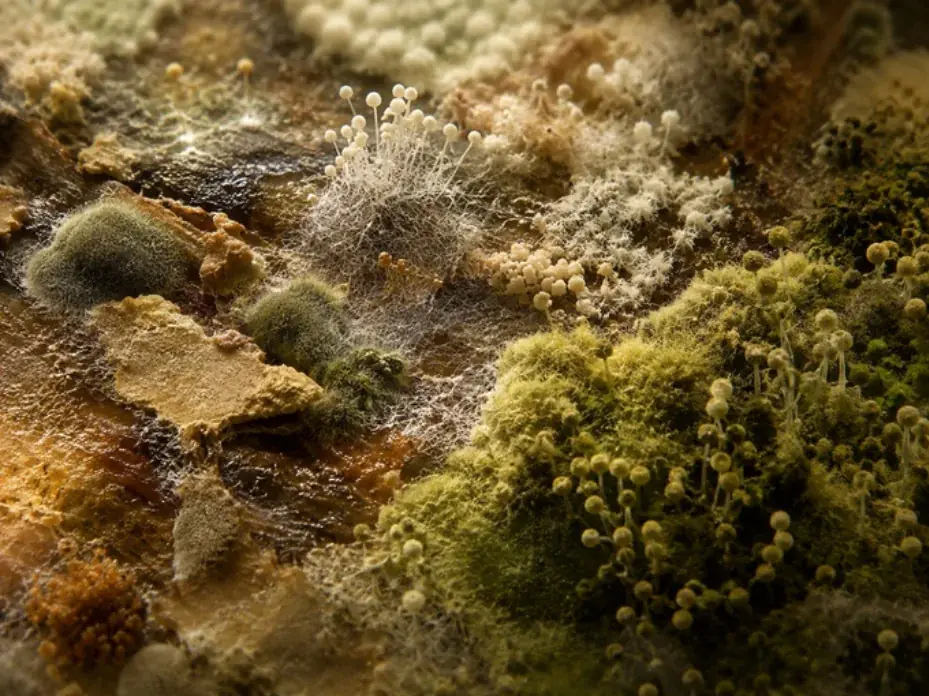
Recent research confirms that climate-related factors are already changing fungal community structure. Elevated CO₂ levels and rising temperatures have been shown to alter the composition of arbuscular mycorrhizal fungi associated with maize and wheat roots. Although total diversity did not change significantly, the dominant species shifted, suggesting that climate pressure may reorganize fungal hierarchies even when the total number of species appears stable (Liu et al., 2023).
A similar pattern can be seen indoors. A two-year monitoring study across nine museum storage facilities found strong links between microclimate fluctuations—especially changes in temperature and relative humidity—and shifts in fungal abundance and community composition. These findings show that indoor fungal communities are highly sensitive to climate variability. They do not respond only by increasing or decreasing in number; they also change through species turnover, dominance shifts, and structural reorganization (Derksen et al., 2025).
However, climate change does not always increase fungal diversity. In urban heat islands, sealed buildings, or poorly ventilated environments, increased rainfall combined with reduced airflow may limit the movement of outdoor microorganisms into indoor spaces. In such cases, overall diversity may decline. Yet this does not necessarily mean lower risk. Instead, a smaller number of mold species may become more concentrated, more resilient, and better adapted to specific damp corners, wall cavities, storage zones, or material crevices.
This distinction is critical for risk management. A space with lower fungal diversity can still be dangerous if the dominant species are highly moisture-tolerant, heat-tolerant, or capable of forming stable biofilms. Some molds can also produce sticky extracellular substances that help them attach to surfaces and persist within microenvironments, making them harder to remove and more likely to return after cleaning (Aguilar-Marcelino et al., 2021).
In extremely humid or water-damaged environments, fungal communities often shift in favor of mold species that can rapidly colonize materials and exploit moisture. In enclosed settings without visible water intrusion, diversity may decrease, but the functional strength of specific mold communities may increase. In other words, climate change is not only changing how much mold exists. It is changing the identity, behavior, and persistence of mold communities.
This changes how mold risk should be evaluated. Visible growth and total microbial counts tell only part of the story. The more important question is which species are becoming dominant, under what material conditions, and how their functions affect product quality, indoor air, storage stability, and long-term material durability. As climate change blurs the boundary between outdoor and indoor microbiomes, mold diversity becomes a practical signal of environmental instability and emerging material risk.
Extreme Rainfall and Flooding as Accelerators of Mold Outbreaks
Extreme rainfall and flooding do not only damage buildings. They can reset the microbial environment inside them.
As climate change increases the frequency and intensity of extreme weather events, buildings are being exposed to longer and more severe moisture stress. According to the IPCC Sixth Assessment Report, every 0.5 °C rise in global average temperature is associated with a significant increase in both the occurrence and severity of extreme rainfall events, with high confidence. For indoor environments, this means more frequent heavy rain, leaks, water intrusion, and prolonged dampness. These conditions raise the moisture content of walls, floors, insulation, wood, paper, textiles, and stored materials, allowing fungi to grow not only on surfaces but also deep within building structures.
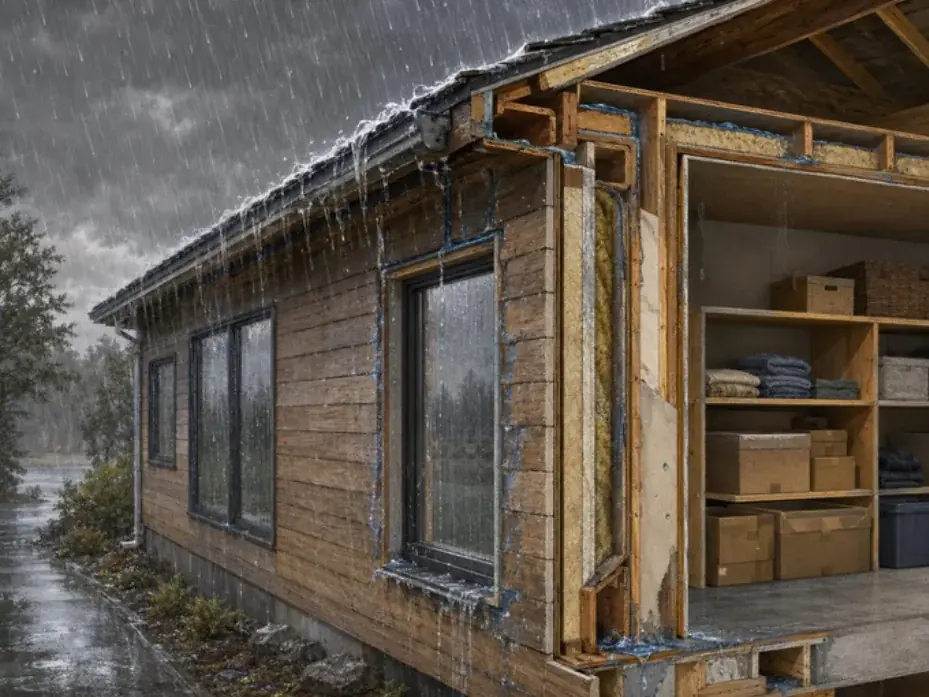
The consequences can appear quickly after a disaster. Following Hurricane Katrina in 2005, visible mold contamination was found in 46% of surveyed residential buildings in New Orleans. In some affected areas, airborne spore concentrations rose from 82,000 spores/m³ to 630,000 spores/m³, showing how rapidly flooding can turn localized water damage into a community-scale indoor air quality crisis (Chew et al., 2006).
A similar warning emerged after Hurricane Harvey in 2017, when the U.S. Centers for Disease Control and Prevention reported cases of invasive mold infections among immunocompromised individuals. These cases underline a critical point: post-flood mold exposure is not only a building maintenance issue. For vulnerable populations, it can become a serious health risk. Together, these events reveal a clear causal chain: more extreme rainfall leads to more indoor moisture, deeper material dampness, and faster mold proliferation.
Environmental monitoring and clinical studies continue to support this pattern. Post-disaster research has shown strong positive relationships between flood depth, building dampness, and indoor mold concentrations. When buildings remain above 75% relative humidity or when material moisture content stays above 15% for extended periods, mold growth can accelerate dramatically. Under these conditions, high-moisture indicator species such as Stachybotrys chartarum, Aspergillus niger, and Cladosporium cladosporioides are frequently detected. These molds can colonize damaged surfaces, persist in porous materials, and reactivate when residual moisture becomes available again.
This is why flood-related mold risk does not end when the floor looks dry. Porous materials can continue to hold moisture long after visible water has been removed. Wall cavities, insulation, wood panels, cardboard, leather, textiles, and stored goods may remain damp enough to support hidden fungal growth. Once colonies mature, later drying, airflow, renovation, or physical disturbance can release spores and fragments into indoor air.

Extreme rainfall and flooding also reshape local fungal communities. Species that were once rare or limited to wet microenvironments may become dominant after prolonged water intrusion. Moisture-loving molds can gain a temporary but powerful advantage, colonizing materials faster than normal indoor competitors. As these events become more frequent, “climate-driven mold outbreaks” are likely to become less exceptional and more routine.
This changes the logic of flood recovery and prevention. Surface cleaning and short-term drying are no longer enough. Buildings, storage areas, and material inventories require longer moisture monitoring, material assessment, ventilation control, and post-remediation verification. In a climate of heavier rainfall and more frequent flooding, mold prevention must move from emergency response to climate adaptation.
Conclusion
Molds reveal a hidden biological dimension of climate risk. As temperatures rise, humidity patterns become less predictable, and extreme rainfall becomes more frequent, mold risk is moving beyond damp corners and isolated building problems. It is becoming a broader signal of environmental instability, affecting materials, indoor air, public health, and long-term building resilience.
The central lesson is that mold prevention can no longer depend only on historical climate patterns or visible contamination. Fungi are expanding into new regions, reorganizing into new communities, and responding quickly to moisture shocks after extreme weather events. These changes make mold risk more chronic, systemic, and difficult to manage through short-term remediation alone.
Future strategies must shift from reactive cleanup to proactive climate adaptation. Fungal monitoring, resilient materials, moisture control, building design, and post-disaster verification need to work together. In an unstable climate, molds are not just organisms growing in the background. They are early biological signals of whether our built environments are prepared for the conditions ahead.