Temperature-Driven Mold Secondary Contamination
SCIENCE · MOLDNEWS REVIEW
By the YCM Mold Research Center · July 2026 · MoldNews Review Vol.1 Issue 1, p.04
Why indoor air quality can deteriorate suddenly without visible mold growth—and how temperature changes can trigger large-scale secondary contamination.
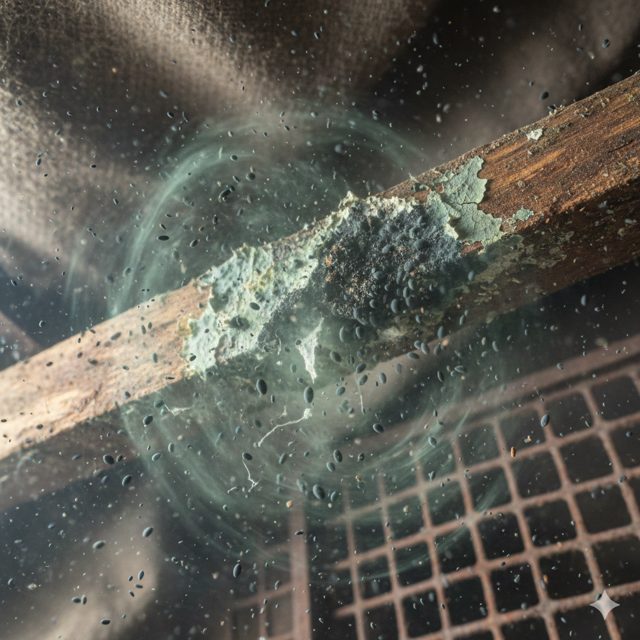
In environments where moisture or temperature–humidity balance is disrupted, attention often focuses on visible mold growth. However, the greater risks to health, materials, and indoor air quality usually come later. When mold colonies dry out, experience temperature changes, or are physically disturbed, mature spores, hyphal fragments, and mycotoxins can quickly become airborne. At that point, contamination is no longer confined to surfaces. It becomes inhalable, spreads through the air, and expands into previously unaffected areas.
This kind of secondary contamination does not occur randomly. It depends on three closely linked factors: how mature the spores are, how fragile the mold colony structure has become, and whether airflow or vibration is present. Temperature plays a central role in all three. It controls how quickly spores mature, affects moisture loss and material cracking within the substrate, and even influences how efficiently spores can germinate after release. When temperatures fluctuate, mold risk can shift suddenly from seeming stability to large-scale spore release, creating exposure conditions that are far more harmful than visible growth alone.
Temperature Governs Metabolic Rate and Sporulation Dynamics
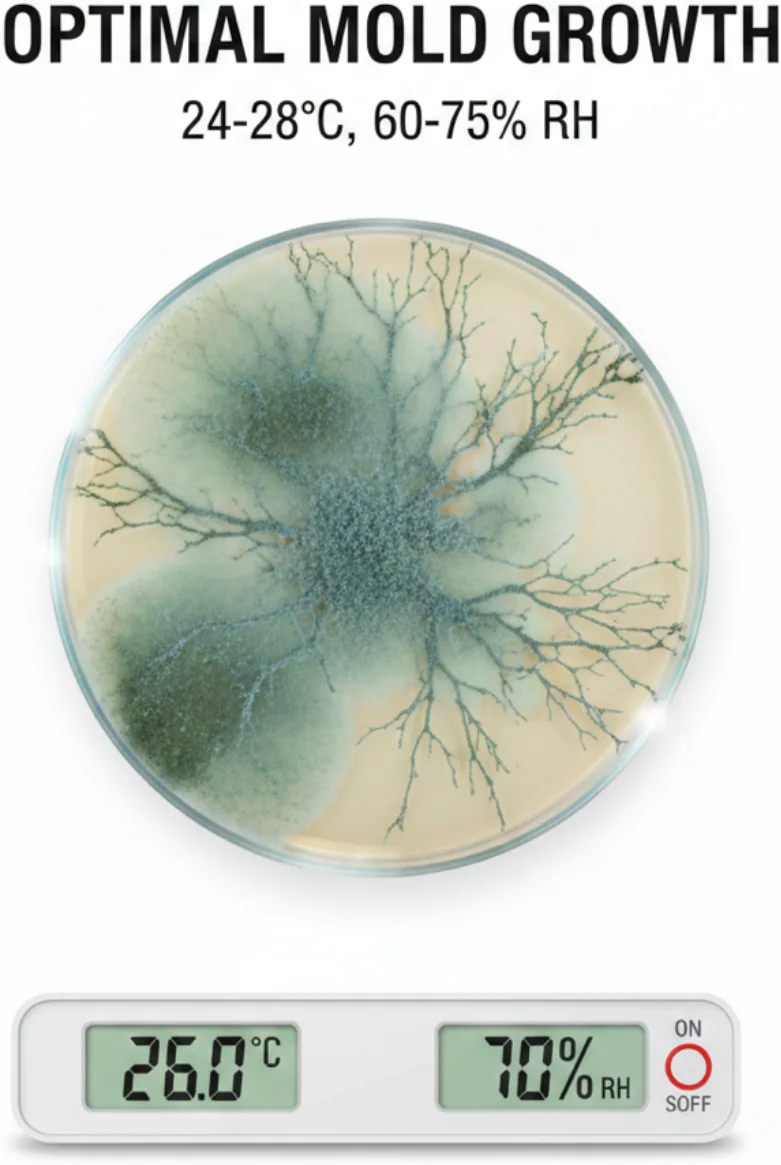
Most indoor molds are mesophilic organisms that grow within a moderate temperature range, roughly between 5 and 35 °C, with optimal activity around 24–28 °C. (Zhan et al., 2021; Pasanen et al., 1991). Within this window, enzymatic reactions and respiratory metabolism operate efficiently, allowing spores to germinate more quickly and hyphae to extend at their fastest rates. Under stable conditions combining these temperatures with moderate humidity, mold colonies can expand rapidly and establish dense biomass. (Zhan et al., 2021).
As temperatures drop, growth slows noticeably. When conditions shift from around 25 °C down to the mid-teens, spore germination takes longer and hyphal extension becomes sluggish. This slowdown reflects basic physiological limits: enzyme activity decreases, and cell membranes become less flexible, making growth energetically less efficient even if moisture remains available (Pasanen et al., 1991).
Importantly, the temperature that favors growth is not always the same temperature that favors sporulation. Many mold species prioritize vegetative expansion under warm, humid conditions, investing energy in building biomass rather than producing spores. As temperatures decline but remain within a viable range, this strategy can shift. Cooling conditions often trigger increased sporulation, allowing the colony to convert accumulated biomass into large numbers of mature spores. For example, a seasonal temperature drop from around 28 °C to 20–22 °C under sufficient humidity can initiate widespread sporulation, setting the stage for significant spore release once drying or disturbance occurs.
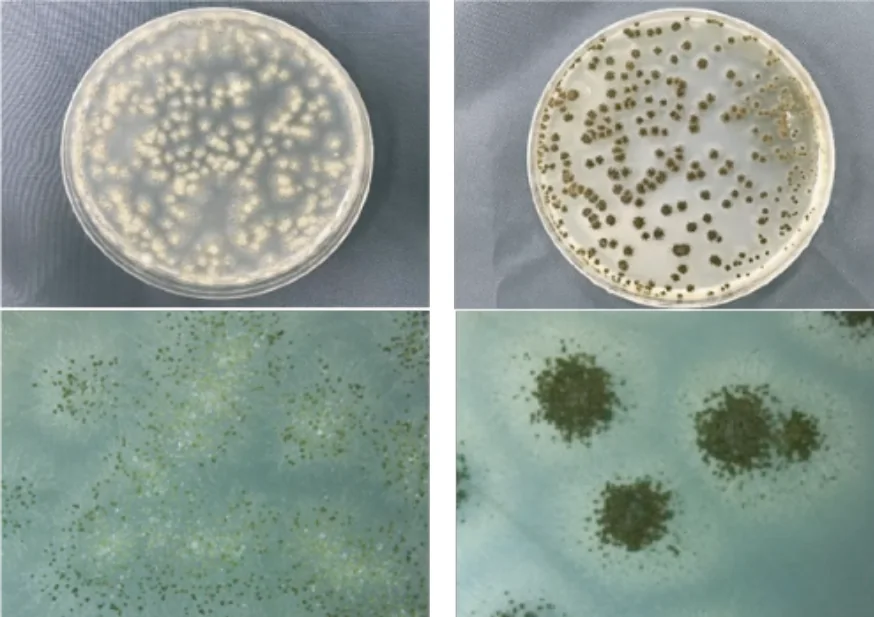
These patterns were clearly demonstrated in thermal cycling experiments conducted by the YCM Mold Research Center. During warming phases between 25 and 40 °C, extensive hyphal networks developed at lower temperatures, while spore maturation accelerated markedly at higher temperatures. During cooling cycles from 40 back to 25 °C, abundant sporulation occurred at elevated temperatures, and mature spores persisted through cooling without a corresponding increase in vegetative growth. Together, these observations show that elevated temperature primarily speeds up reproductive maturation, rather than simply increasing surface growth.
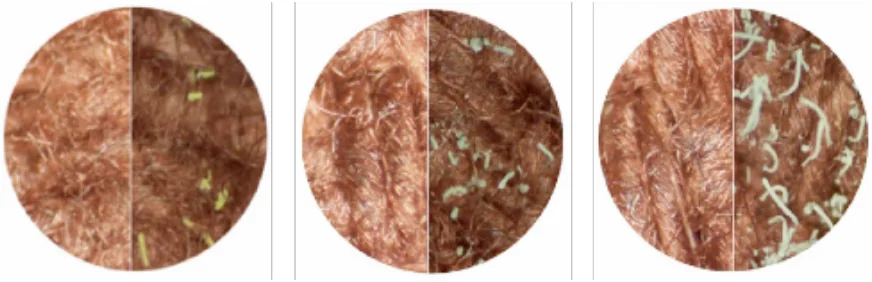
Similar trends were observed across different material substrates. In YCM tests on cotton, leather, and polyester, cultures maintained at 40 °C formed dense colonies within four days and reached advanced spore maturity well before those grown at 25 °C. Lower-temperature cultures showed slower growth, sparse colonization, and delayed sporulation. Although the materials differed in moisture retention and surface properties, their thermal response patterns were consistent: higher temperatures pushed colonies more quickly toward maturity and early accumulation of large, release-ready spore reservoirs.
Taken together, these findings highlight temperature as more than a general growth modifier. By controlling the transition from vegetative expansion to reproductive maturity, temperature sets the conditions that determine whether a mold colony remains surface-bound or becomes a potential source of airborne contamination. In this way, temperature acts as a primary driver in the early stages of secondary contamination cascades.
Temperature-Driven Spore Dispersal via Hygrothermal Cycling
Temperature influences mold dispersal not only by shaping fungal physiology, but also by controlling how moisture moves in and out of building materials. In many cases, spores are not released simply because humidity is high, but because temperature changes drive repeated wet–dry cycles and sudden microclimate shifts that weaken colony attachment.
- Condensation on Cold Surfaces
Warm humid air contacting cold surfaces (exterior walls, glazing, refrigerant lines) undergoes cooling below dew point, precipitating immediate condensation that elevates local humidity to saturation. Even at 60% ambient RH, these thermal bridges sustain prolonged condensation, generating localized hypersaturation that promotes colony hydration and expansion.
- Temperature-Dependent Humidity Gradients
Constant absolute humidity yields divergent relative humidity across thermal zones—60% RH at 25 °C may reach 85% in 15 °C microclimates. This establishes discrete hygric zones within building envelopes, causing selective surfaces to approach critical thresholds for fungal development or structural transition.
- Thermal Fluctuations Driving Hygric Cycles
Diurnal oscillations, seasonal transitions, and HVAC cycling impose iterative sorption-desorption on substrates. Hydration phases enable colony expansion with continued vegetative growth and sporulation; subsequent desiccation induces substrate moisture loss, hyphal network contraction, and matrix fracturing, diminishing adhesive forces and priming spore detachment. This hygrothermal cycling constitutes the dominant physical mechanism underlying secondary aerosolization.
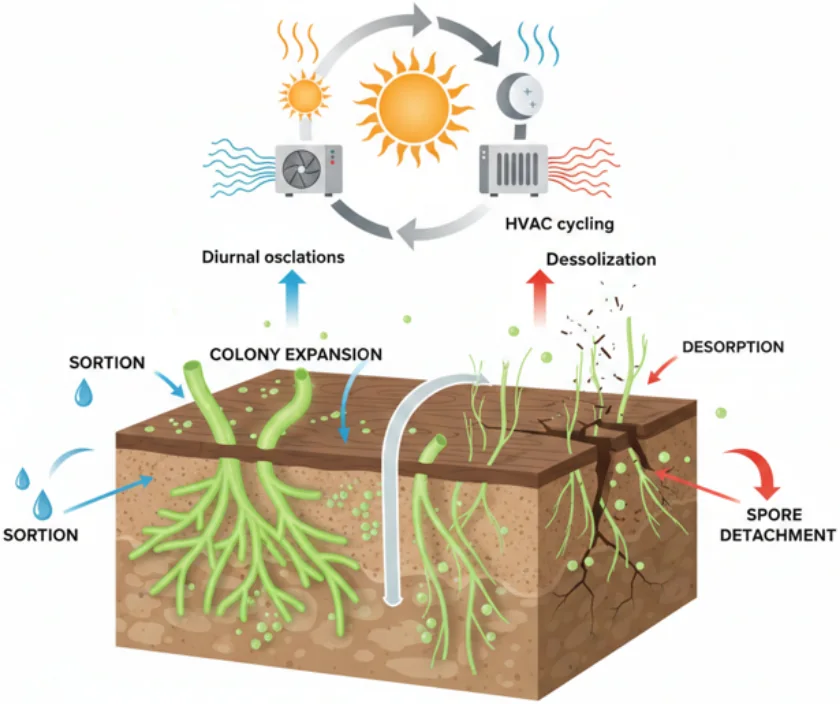
Different types of mold respond very differently to environmental change, largely because of their inherent biological traits. Sudden shifts in temperature or humidity can therefore trigger very different spore-release behaviors depending on the mold type.
Xerophilic molds, such as Aspergillus, Penicillium, and Cladosporium, are especially sensitive to rapid drying. When indoor conditions are warm and humid and dehumidification, heating, or air conditioning is suddenly activated, temperature or relative humidity can change quickly. This causes mold colonies to lose water almost instantly and contract. As dehydration progresses, the extracellular materials that normally bind chains of spores begin to break down, allowing spores to detach easily. Under these conditions, even minimal airflow or light vibration can release large numbers of spores into the air (O’Gorman & Fuller, 2008; Górny et al., 2002). Because these spores are typically small (around 2–10 μm), they can remain suspended for long periods and are among the most common contributors to indoor air quality degradation.
Hydrophilic molds, such as Stachybotrys chartarum and Chaetomium, behave quite differently. Their spores are embedded in thick, moisture-loving matrices that strongly adhere to surfaces under high humidity, making spontaneous dispersal unlikely. However, when these molds experience rapid drying, sudden temperature increases, or strong mechanical disturbance such as demolition or renovation, the colony structure can fail abruptly. This can lead to short-duration but intense release events, ejecting spores, hyphal fragments, and toxin-associated particles into the air (Tucker et al., 2007; Dyląg et al., 2022). These explosive release episodes are generally considered to pose higher health risks than the gradual spore dispersal typical of xerophilic molds.
An important and often overlooked factor is the positive feedback between temperature and release risk. Elevated temperatures accelerate mold growth and spore production, leading to denser, more mature colonies. These mature structures, while biologically robust, are mechanically fragile when exposed to sudden drying or cooling, making them more prone to rupture and mass aerosolization. Field observations frequently show this cascading pattern: temperature-driven maturation followed by thermal or humidity shock, resulting in a sharp increase in airborne contamination.
T–RH–Time Integrated Model
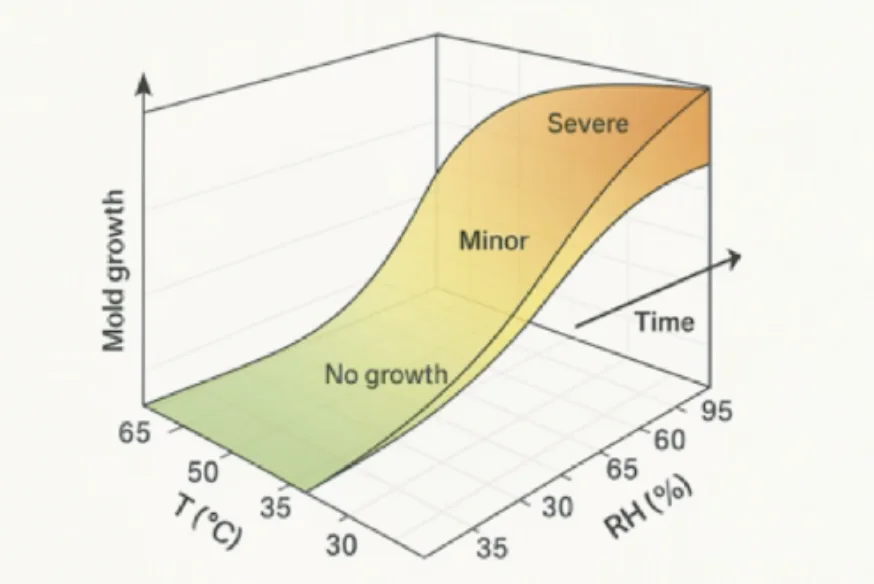
Temperature (T), relative humidity (RH), and exposure duration are the three main environmental factors that shape indoor fungal risk. Looking at any one of these on its own rarely tells the full story. Mold growth, maturation, and eventual release into the air become much easier to understand and predict when temperature, humidity, and time are considered together.
Relative humidity is the primary trigger for fungal activity. It functions as the biological “on–off switch” for growth. Most indoor molds require water activity above aw 0.80 to initiate metabolism (Mannaa & Kim, 2017), and sustained RH above 80% allows growth across a broad temperature range (approximately 10–30 °C). In contrast, maintaining RH near 60% strongly suppresses growth even when temperatures are otherwise favorable. As a result, RH is widely recognized as the dominant environmental control in indoor fungal risk.
Temperature regulates the speed of fungal development. Warmer conditions accelerate enzymatic activity, hyphal growth, and spore production, allowing colonies to reach maturity more quickly. Temperature fluctuations can also amplify moisture cycling, weakening colony structure and increasing the likelihood of spore release. In this sense, temperature determines how fast risk escalates once humidity thresholds are exceeded.
Time defines whether risk can fully develop. Fungal growth and maturation require sustained exposure, not brief excursions. Materials exposed to elevated RH for multiple days are far more likely to support colonization, and higher temperatures shorten the time needed to reach hazardous, spore-rich stages.
Germination tests conducted by the YCM Mold Research Center provide clear, practical evidence of how temperature influences a mold’s ability to recolonize after dispersal. Under the same starting spore concentrations, spores that had developed under higher temperatures showed a 50% germination rate, compared with only 10% for those formed at lower temperatures. This fivefold difference means that once spores become airborne, those conditioned by warmer environments are far more effective at establishing new growth, even under barely permissive moisture conditions near the minimum water activity threshold.
Taken together, these findings show that the T–RH–Time framework goes beyond simply predicting whether mold will grow or not. It helps explain when colonies are likely to mature, how temperature and moisture cycles can trigger spore release, and why recolonization can happen so efficiently after dispersal. By looking at temperature, humidity, and time as a connected system, risk assessment shifts from static snapshots to a more realistic, dynamic picture of how mold behaves and persists in real indoor environments.
Conclusion
Fungal risk does not come from a single factor acting alone, but from a chain of environmental changes working together over time. Humidity determines whether mold can start growing, but the shift from surface contamination to airborne spread is largely driven by temperature. As temperatures rise, mold matures faster and builds up large numbers of spores. When this is combined with moisture and temperature cycling, colonies become unstable and more likely to break apart. As a result, sudden indoor air quality problems are usually caused not by rapid new growth, but by temperature changes that push already mature colonies past their release threshold.
From a practical risk management perspective, controlling mold is less about reacting to individual readings and more about understanding how temperature, humidity, and time move together. Keeping materials from staying damp for long periods, avoiding sharp heating or drying after mold has formed, and reducing airflow or physical disturbance can greatly lower the chance of spores becoming airborne. In this way, effective mold control goes beyond simply lowering humidity and focuses on managing temperature-driven progression across the entire contamination process, helping prevent secondary spread before it occur